Thursday, April 23, 2015

Final Course Deliverables & Deadlines

1. Your written exam is due by May 1 at noon. 

Please drop off at 116 RPH. If I am not here, please slide it under my door.

2. Reel and Artist Statement is due May 1 by 5 PM

Embed your reel (45 sec to 1 min) edited "sizzle" highlights of all your best work. This footage can be anything that you have filmed. Also include a 350 to 500 word artist statement with our reel. Detailed instructions are in the post below.

3. Peer Feedback of Reels due by Monday, May 4 at noon.

Watch reels posted by classmates after Friday, May 1 at 12 pm. Comment on each reel to show support and that you have watched their work.

4. Final Blog post due on May 4 at noon.

Please think about what you knew about visual storytelling and videography, and what technical skills you had at the start of this course in January, and where you are now. What have you learned about storytelling? What have you learned about being a cinematographer? What have you learned about yourself (what you are good at and what you don't enjoy)? What skills have you developed through learning in this course? This final course reflection should be 350 to 500 words, posted on your blog.

5. If you are up for it - please do a course evaluation available in Student Tab of MyBama.

GRADES ARE DUE MAY 5.

Any blog posts completed by NOON on Monday, May 4 will receive credit. Any blog posts missing will be deducted from  your grade. No late assignments past this deadline will be accepted.


Reel and Artist Statement

For our final assignment you must edit a 45 sec to 1 minute reel of your work as a videographer - this means all the footage you have shot (in any classes or projects) is allowable. If you are low on content you may create a Director/DP reel but you must specify what you filmed and what you directed.

FOR  YOUR REEL: Keep in mind lots of folks have many different reels for different kinds of jobs they pitch for but for this assignment, choose your favorite shots (for their look/aesthetics) and put them together in a way that represents your style and technical skills.

You are also encouraged to browse old 312 sites and see what your peers have put together. 

Visit the right sidebar, scroll down for pasts 312 reels: http://thedocisfeelinginspired.blogspot.com


Additionally post a short ARTIST STATEMENT (350-500 words) with your embedded video clip, see below for some examples of reels and artist statements.

Browse blogs of previous 312 students to read their artist statements. For example: Ellen, Lauren, Mary Katherine, Austin, Tanner and Danny. Scroll down the sidebar and read more --- there are tons!


TIPS FOR WRITING AN ARTIST STATEMENT:


Here are some examples:


Thursday, January 22, 2015

Documentary Storytelling Portrait - Assignment Examples

Reminder: RESERVE YOUR EQ at least 48 HOURS IN ADVANCE! 

Your email should include the following:
TCF 312
Your Name
Pickup Date:
Return Date:
Detailed list of EQ desired (BE SPECIFIC!), for example: SONY EX3, Gitzo or new Manfrotto tripod, battery, charger, white card, shotgun mic (or onboard camera mic --- pay attention at least one camera is missing the onboard shotgun mic), fishpole, Sennheiser headphones

Example VideosWe will watch some of these examples in class but I encourage you to watch as many as you're able. Note: due to snow day, we won't have time to watch in class. 

When you watch the examples, consider WHAT is the story or stories being told (what do you think is the filmmaker's message, or what do you take from his/her piece?), and HOW is the story told visually. What are the levels of filmmaking - technical skill, aesthetics/style, color, camera work, etc... being deployed to work in service of the media message? Think CONTEXT, CONTENT & FORM.

Here are some (hopefully) inspiring examples:
Brian B+ Cross "KEEPINTOKYO" and "TEEBS"

pouringdown.tv - "of all the things that can happen" and "the skies uptown"


Examples from past 312 students:


Lynita Motes Art from Jana Patton on Vimeo.


TCF 312 Portrait of a Place from Henry Busby on Vimeo.


The 15th Lake from Xavier Burgin on Vimeo.


Examples from projects on Vimeo:

 Harlem Elvis from John X. Carey on Vimeo.


Kickflip from I Am Los Angeles on Vimeo.


Look Up at the Stars, Portugal! from Matty Brown on Vimeo.


Shelter from the Storm from John X. Carey on Vimeo.


The Guardian from Carly Palmour on Vimeo.


D-Nice Presents: Experiencing The Dream from D-Nice on Vimeo.


2012 True School Park Jam Series Trailer from Noisemaker Media on Vimeo.


Please also see what other TCF students have done before you. Visit the right sidebar and look for "Portrait of a Place" in the blog post title.


Sunday, January 11, 2015

Welcome to the Spring 2015 Course Blog!

10 THINGS I LIKE TO WATCH  - Dr. Raimist

Be warned that my test is very eclectic. I love all different genres, eras of film, and I'm a sucker for anything with the right leading man, and of course it's all about moving cinematography!

The beautiful film shot by made by one of my beloved directors, Ava DuVernay, and was shot by one of my favorite cinematographers Bradford Young, SELMA!


The title song just won original song from a motion picture at the Golden Globes!


DO YOU WANT TO SEE IT? 
Be one of the first 75 students with ACT cards and see it for free on MLK day at The Cobb. RSVP HERE!


And here are my other faves:

10.) The film that I watch and re-watch over and over again, is SAY ANYTHING.


(The music in the film is not as cheesy as in this trailer, I promise! It opens with "Taste the Pain" from The Red Hot Chili Peppers and who doesn't love them?!)


The best writing of romantic and most funny and incredible one-liners ever.


9.) SEVEN


The cinematography is breathtaking in the darkest of creepy ways. The scenes lit with Brad Pitt and high powered flashlights - be still, my heart.


8.) Just watched NAS: Time is Illmatic


Fun fact: I know every word to every song on "Illmatic" and I can rap it all, but I won't do it publicly... so don't ask! ;)

7.) Favorite music video from my generation: "DROP" by The Pharcyde


Yes, Spike Jonze, yes! Can you figure out how they shot this?


& Here are some of the things I'm currently watching on TV and streaming devices:

6.) RIVER MONSTERS

I like more docu-reality programming, and I would run away to film with my love, Jeremy Wade, in a heartbeat.


5.) COMMUNITY (via Hulu Plus)

I started with Season one two weeks ago, and now Troy just left and things are not the same and I don't know how I can go on.


4.) THE MINDY PROJECT

Despite the recent article that said I should hate Mindy, I love her. I am (part) Mindy, I am.


3.) GREY'S ANATOMY

I know that I'm 10 years late, but it took me a decade to deal with ER ending, so over the last break I watched a decade's worth of seasons... yes, that was many hours of McDreamy and McSteamy


2.) THE VAMPIRE DIARIES

I know he is bad, but I love Damon Salvatorre. And, I also love the lighting - show low-key and shadowy and rich and luscious to watch.


1.) THE FOSTERS


I am not the most conventional person. I don't have the most conventional lifestyle. I raise my own children to be free. I love love and folks who make family out of love... And, of course, I love Sherri Saum.  Who doesn't?

And I love scenes with beautiful string lights, just out of focus in the background.


& During the TCF In LA tour of Warner Brothers I saw her, screamed hi, and she smiled and waved at me... yes, me, and just me!

Thursday, November 20, 2014

Reel & Artist Statement

For our final assignment you must edit a 1 minute reel of your work as a videographer - this means all the footage you have shot (in any classes or projects) is allowable. If you are low on content you may create a Director/DP reel but you must specify what you filmed and what you directed.

FOR  YOUR REEL: Keep in mind lots of folks have many different reels for different kinds of jobs they pitch for but for this assignment, choose your favorite shots (for their look/aesthetics) and put them together in a way that represents your style and technical skills.

Search online for some examples:
"Cinematography Reel"
"Director of Photography Reel"

"Videography Reel"


Here are some past 312 reels:


Director/Cinematographer Reel: Spring-Summer 2012 from Connor Simpson on Vimeo.


You are also encouraged to browse old 312 sites and see what your peers have put together. 

Visit the right sidebar, scroll down for pasts 312 reels: http://thedocisfeelinginspired.blogspot.com


Additionally post a short ARTIST STATEMENT (350-500 words) with your embedded video clip, see below for some examples of reels and artist statements.


TIPS FOR WRITING AN ARTIST STATEMENT:


Here are some examples:


Thursday, October 2, 2014

Scene Assignment Example - Xavier Burgin


From Xavier: As an filmmaker I can't stress enough how important it is to make a detailed binder that completely encompasses your entire film. One of the problems you get with people who are creative is the fact they come up with amazing ideas, but they can never make it a solid, tangible package.

They're too busy making one awesome idea rather than building an entire story. It's cool to have a gimmick or set up the story is based around, but without a good story you have nothing. When it comes to film, you really need to have everything planned out even to the most minute detail.

Many filmmakers rush a film without planning the logistics and fail. Here are two rules you can live by.

1. A scene will always take longer than what you predict
2. It's not if a mistake will happen. It's when.

This is why you want to be as organized as possible. So I want go over how I make a production package.

1. Actor's Info, Crew Info, Location Info, Prop Info, Contracts (Actor's Release, Location Release, etc...)
2. Script
3. Shot List
4. Storyboard
5. Floor Plan
6. Scheduling
7. Shooting Script
8. Visual References
9. Revised Pages
10. Equip List
11. Miscellaneous


This may seem overboard, but I'm going to explain each one and why you should do it.

First, get notebook dividers that have numbered division. You can also get colors, it doesn't matter. Just make sure to buy enough to throughly divide your work.

Before I begin on the first page.

 I have one lone page that has my logline, a short description of the film (two paragraphs usually), and then a story summary (around four to five paragraphs).

You need to be able to explain your film in one sentence or in a few paragraphs. In the story summary write out your first act, second act, third act, and conclusion. Do not skip over a part of your story you are unsure of. If you have not figured it out in your summary, you probably haven't fleshed it out in your script.

1. The first divider will be for all of the actor's info, crew info, contracts, location info, and props. As you are looking for actor's and locations write down who the person is or who owns the location. Write down all the props you'll need to buy for the film.

This will help you to keep everything you are doing at the beginning of pre-planning in check. Be sure to get Actor Release Forms and Location Release Forms to avoid legal trouble. You can find pre-made ones anywhere online.

2. This is a no brainer. You must have a script before shooting a film. Don't wing it. Don't say I have it all in my head. You don't!

You are going to waste someone's time if you don't put it on paper. When you write the script follow proper screenplay format.  Download screenwriting software, Celtx.

Have someone else read your story. You will always be bias to your work. You will always think it's good when it might be a polished turd.

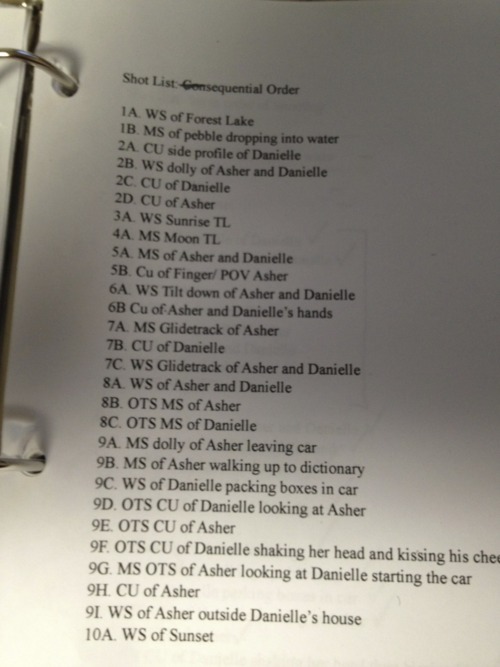
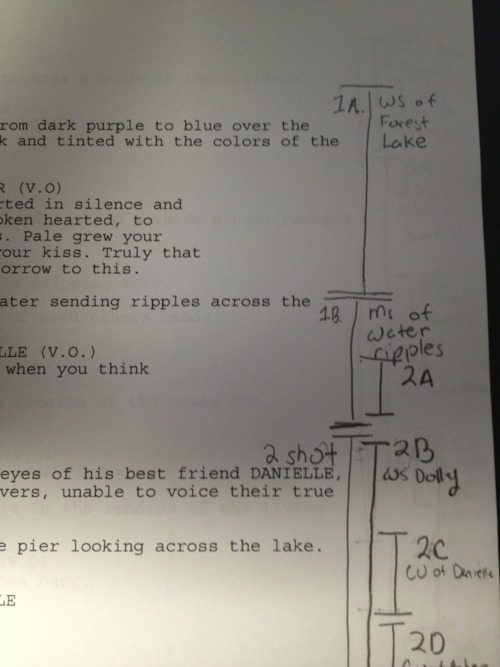
3. Your shot list covers all of the shots you will need in your film. This ties in with your storyboard. You might end up doing them both at the same time or one before the other. It's based on you, but I recommend doing your shot list first.

 Go through your script and visualize every scene (how you place your characters, where do cuts happen, movement, etc...) and write out what it would look like.

Ex.
Scene 1A - Medium Close Up of Emma sighing and reaching for pen
Scene 1B - Close Up of hand reaching for pen
Scene 1C - WS of Emma picking pen up then standing up and walking out of room
Scene 2A - WS of Emma walking out of room and into hall

Shot List in Sequential Order

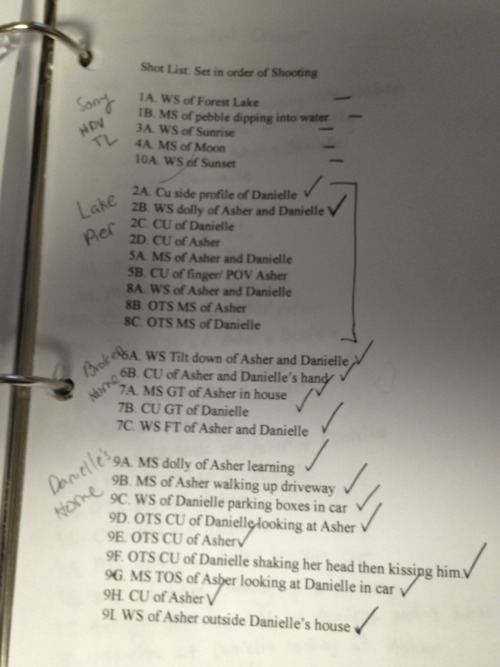
Shot List Based on Scenes we will shoot based on availability of actors and locations
(this is a Shooting Schedule, when you add times that each shot will be filmed!)

Those were a little more detailed than what you'll need, but it's your preference. Go through your entire script and figure out how many shots you'll need and list them by scene, then in order alphabetically.

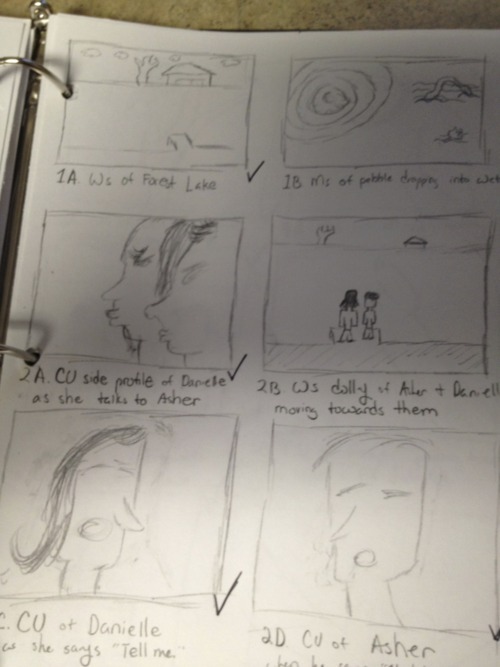
4. Your storyboard is the visual representation of your film. It is (in my opinion) one of the most important parts of understanding your film's aesthetic.  You may say, 'Well I can't draw."


Tough luck, draw stick figures because you NEED to do this. If you're ashamed of your drawing skills sit down with someone who can help you visualize. This will be tedious and time consuming. Do it. You will thank me later.

5. So you've figured out your shots and have a decent storyboard. Cool, during this time you should be out scouting location.

Take a camera with you and photograph all angles of the location. If you don't have a camera handy (YOU SHOULD! Why don't you have your own camera! You love film don't you! Eat Ramen Noodles and save up those pennies!) take the photos with your phone.

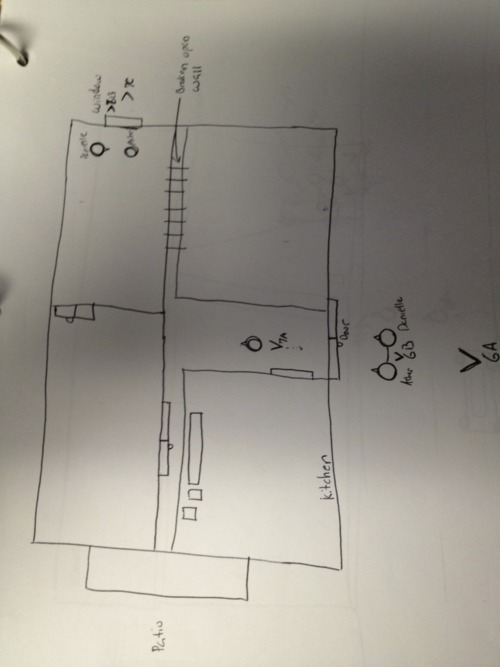
Once you have the pictures it's time to make an outline of the location from a bird's eye view. Account for tables, chairs, extra rooms, etc...)

You'll notice that ovals with small triangles on them and V's on the paper. The ovals represent the actor's blocking and the small triangles represent his nose. This is so we know where the actor is facing and the direction of camera's shot.

6. I did not put anything into the binder for scheduling since I constantly updated scheduling through email and Google Docs. Once you have locations and actors you're going to need to figure out when they are available. You also need to know (based on your script) what time of the day you want certain scenes to be shot.

You will then need to  coordinate with your actors and crew for Crew Call (when the crew must be at the location) and Actor's Call (when actors must be at location),  what days and times you'll have certain actors, what days and times you'll have certain locations, and (based on the previous) when you can shoot certain scenes.

I've done this on my own several times. I don't like it, so I usually work with or hire a Producer (individual who handles the non-creative logistics such as telling actors where and when to be, figuring out your film budget, etc...) who will look over all of this and figure it out for me.

A Producer is invaluable. Even in college, if you want to have a smooth film, you should go ahead and link up with individuals who take themselves seriously, and enjoy brining a film together on the business side.

7. This one is pretty simple. Remember when I told you to visualize how each scene in your script will happen shot by shot? Now, put your shot list on the side of your script by where it corresponds with the script. Do this to your entire script.


8. Visual References are just pictures, notes, poems, or anything that embodies the aesthetic your film is trying to achieve.  For this pre-production package, I wanted a sense of destruction counteracted by the beauty of nature (specifically a lake). Here are two of my visual references.

9. NEVER throw away anything. Even when you are done with it you never know when something may fall out or you forget an updated script or shot list. At least if you have your old work you can go back and try to remember what you revised. Never throw away anything you've written.

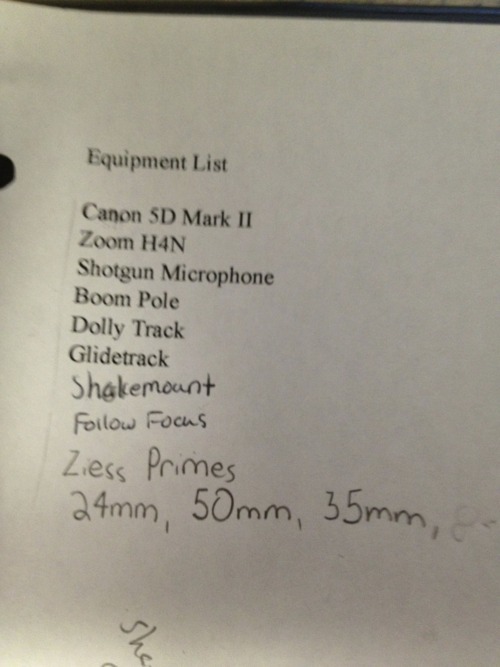
10. This one is straightforward. Just write out the equipment you feel you will need to finish this project.

(Dr. Raimist Note: it is spelled ZEISS!)

11. Finally, anything else that doesn't fit into these categories will go into Miscellaneous.
That's a full production package. Next time you shoot a film take out the time to make something extensive and detailed. If you think this is overkill, I assure you you're going to have a hard time making your vision come to life.

Film Made With Production Package Shared Above:


Feel free to contact me for any questions at quethelights@gmail.com.

Vimeo Turner Doc from Ellen Schwartz on Vimeo.

Friday, September 12, 2014

Thursday, September 4, 2014

DOCUMENTARY STORYTELLING ASSIGNMENT EXAMPLES

Reminder: RESERVE YOUR EQ at least 48 HOURS IN ADVANCE! 

Your email should include the following:
TCF 312
Your Name
Pickup Date:
Return Date:
Detailed list of EQ desired (BE SPECIFIC!), for example: SONY EX3, Gitzo or new Manfrotto tripod, battery, charger, white card, shotgun mic (or onboard camera mic --- pay attention at least one camera is missing the onboard shotgun mic), fishpole, Sennheiser headphones

Example VideosWe will watch some of these examples in class but I encourage you to watch as many as you're able. Note: due to snow day, we won't have time to watch in class. 

When you watch the examples, consider WHAT is the story or stories being told (what do you think is the filmmaker's message, or what do you take from his/her piece?), and HOW is the story told visually. What are the levels of filmmaking - technical skill, aesthetics/style, color, camera work, etc... being deployed to work in service of the media message? Think CONTEXT, CONTENT & FORM.

Here are some (hopefully) inspiring examples:
Brian B+ Cross "KEEPINTOKYO" and "TEEBS"

pouringdown.tv - "of all the things that can happen" and "the skies uptown"


Examples from past 312 students:


Lynita Motes Art from Jana Patton on Vimeo.


TCF 312 Portrait of a Place from Henry Busby on Vimeo.


The 15th Lake from Xavier Burgin on Vimeo.


Examples from projects on Vimeo:

Harlem Elvis from John X. Carey on Vimeo.


Kickflip from I Am Los Angeles on Vimeo.


Look Up at the Stars, Portugal! from Matty Brown on Vimeo.


Shelter from the Storm from John X. Carey on Vimeo.


The Guardian from Carly Palmour on Vimeo.


D-Nice Presents: Experiencing The Dream from D-Nice on Vimeo.


2012 True School Park Jam Series Trailer from Noisemaker Media on Vimeo.


Please also see what other TCF students have done before you. Visit the right sidebar and look for "Portrait of a Place" in the blog post title.


Thursday, August 21, 2014

Welcome to TCF 312 - Fall 2014 Term!

This is the COURSE blog for this term's TCF 312: Advanced Videography class.

This blog is a place where I will share:
  • assignment examples
  • online links
  • news items related to class content 
  • assignment examples
  • links to each individual student blog (on the sidebar)

You will use this blog to post items of interest to the whole class, including:

  • group exercises and assignments
  • interesting news items
  • links to new products
  • links to blogs or sites we should all check out

Use YOUR OWN blog to post:
  • 10 required blog assignments
  • your documentary storytelling assignment
  • your scene assignment
  • anything you want to keep as part of your visual journal


Sunday, May 4, 2014

Phantom Flex Demos

As much as Dr. Raimist talked about the Phantom Flex cameras I thought it would be great to give you guys a fun little demo on what they are capable of. Also wanted to tell y'all to have a great summer.

Thursday, April 17, 2014

Reel & Artist Statement

For our final assignment you must edit a 1 minute reel of your work as a videographer - this means all the footage you have shot (in any classes or projects) is allowable. If you are low on content you may create a Director/DP reel but you must specify what you filmed and what you directed.

FOR  YOUR REEL: Keep in mind lots of folks have many different reels for different kinds of jobs they pitch for but for this assignment, choose your favorite shots (for their look/aesthetics) and put them together in a way that represents your style and technical skills.

Search online for some examples:
"Cinematography Reel"
"Director of Photography Reel"

"Videography Reel"


Here are some past 312 reels:


Director/Cinematographer Reel: Spring-Summer 2012 from Connor Simpson on Vimeo.


You are also encouraged to browse old 312 sites and see what your peers have put together. 

Visit the right sidebar, scroll down for pasts 312 reels: http://thedocisfeelinginspired.blogspot.com


Additionally post a short ARTIST STATEMENT (350-500 words) with your embedded video clip, see below for some examples of reels and artist statements.


TIPS FOR WRITING AN ARTIST STATEMENT:


Here are some examples:


Saturday, March 8, 2014

Ellen Kuras, ASC in the NY Times...

She is the cinematographer that mentioned in class last week. The film that I mentioned with the sepia and blue opening is Personal Velocity, directed by Rebecca Miller.


See Ellen's imdb here: http://www.imdb.com/title/tt0295238/?ref_=nm_flmg_cin_19

Read the entire NY Times article, "The Mind's Eye Made Real" 

Here is an excerpt:

Film is highly collaborative undertaking, so it is difficult to attribute the highest importance to any one aspect. As a cinematographer, though, I appreciate how involved and how influential we can be in the creative part of making a film.
A cinematographer is often the one who most closely glimpses a film’s layers of meaning as envisioned in the mind’s eye of the director. It is our challenge to convey these many layers of meaning through the visual, affecting the way a film works emotionally. Each story is different, hence every film has its own created, unique vision, its own look.
How the camera moves, the position and style of lighting, the color palette, even the blocking of actors, establishes the inner meaning of a film.
In collaborating with the director, I try to understand what he or she wants to say with the film -- what is the essence of the film? I create the look of a film according to this subtext because it is not verbally stated. How the camera moves, the position and style of lighting, how the color palette of a film is designed and even the blocking of actors in each scene, establishes the context and world of a film. These elements act as metaphors, but become actual elements of the story...

Sunday, February 9, 2014

      Hello all. I asked Dr. Raimist if I could post a potential resource for anyone who may be interested, and I received the go ahead. I'm providing a link to a forum ran by Roger Deakins. For those who may or may not recognize the name; he is one of the premiere cinematographers in the industry. You have more than likely seen his work: Shawshank Redemption, No Country for Old Men, Skyfall, The Assassination of Jesse James by the Coward Robert Ford, The Big Lebowski, and Fargo, just to name a few of his more familiar works. Deakins has been working in the industry for 30 years now. In his time, he has worked with documentaries, music videos, and largely feature films. He has developed an amazing craft and lighting style that is used beautifully in all of his films.
       Now, Rodger has developed his own approach to his work, and with that, comes a few things of note: he has an involved approach with his work; he operates camera on all his films, and he keeps his crew to a minimum. This means that more often than not, he doesn't hold positions for additional crew like extra camera assistants, camera PAs, or camera trainees. He has the chemistry and work experience with his selected crew. That's not a slight on more inexperienced personnel; it's just a preference he has chosen for his particular type of work environment. However, given his experience and knowledge, Roger knows that he can still serve aspiring film makers in some capacity. That is where he came up with the forum. He has made himself available to questions of potential film makers. If you have a question about a particular setup he choose for this shot, or what he may recommend for something you are working on, a particular piece of equipment; this gives you the opportunity to ask him about it. Now, there is no absolute guarantee that he will get to every question; but, another great advantage to the forum is that it is full of members capable and willing to provide answers to them. The forum has been around for awhile so there are already plenty of materials and comments from Roger that you can read through. The sign up process is simple, free, and only takes a few minutes.
      Bear with me, as I would like to share one more potential resource that may interest you. There are countless film books out there that cover virtually every angle imaginable. However, there is one that I have found to be among the best out there, especially in regard to cinematography: Painting with Light by John Alton. This is a fantastic piece of literature by another renowned master DP. Some of the excerpts may be a tad dated, but many of the fundamentals and practices are still relevant and used in the industry today. It's a great read for anyone interested.
       I hope these resources can be helpful or at least interesting for anyone who looks into them.

Roger's site: http://www.rogerdeakins.com/
http://www.amazon.com/Painting-With-Light-John-Alton/dp/0520275845
I'm sure cheaper copies can be found out there.